Showing posts with label Housing. Show all posts

Tuesday, June 14, 2011

Kiltie Update Umpteen

Further to this, euthanasia will not be necessary even if the good people at Lake Cowichan Animal Rescue (LCAR), Lori and others working to help are unable to find Kiltie a home by June 24th.

Lori, who is a board member, tells me that the LCAR has a no-euthanasia policy. Unless the cat's health warrants it, euthanasia is never considered. Therefore, Kiltie should have as long a life as her little body allows.

Within an hour of arriving home last evening, Kiltie had eaten, re-christened her litter box, checked out her favourite haunts, had some serious cuddles with her original human, and consumed at least one ounce of water. Given Kiltie's size that amount of water is fantastic - the average human, at 150 lbs, is 50 times her weight. Imagine drinking 50 ounces of water in one sitting!

Kiltie had a good night, although she kept trying to get closer to her human. Said human, meanwhile, kept trying to find positions less painful (don't know why I bother) thus disturbing traumatized Kiltie unfortunately.

Kiltie tried to get me up at 3am. No dice. I was too much in pain and too damn COLD, this 14th day of JUNE, 2011 - seven days from the summer solstice.

(When the heck are we going to get SPRING?)

Kiltie - Find the Cat

Anyway, I think Kiltie may be on the mend. She had another decent visit to her water bowl this morning (and since) and ate a full breakfast - I cut down the amount somewhat for fear of her overdoing it. Now Kiltie is in her favourite spot for undisturbed sleep.

Monday, June 13, 2011

My Heart Breaks: Kiltie returns, temporarily

Received this email from Lori regarding Kiltie:

Hi Ocean,

I hope this letter finds you well. I know you are preparing to move, and I send my best wishes your way.

I am sorry to have to tell you this, as I never like to cause worry and stress, but Kiltie has had to go back to the vet twice in the past week. She stopped eating and had a fever. Her saliva pocket also filled up. She is terrified of the dogs, even though they leave her alone and do not bother her at all. All of the dogs keep their distance from the cats. But dear, sweet little Kiltie is just not coming around to being comfortable. She does come out of hiding at night, as when I get up she will come to me then. The other senior cat who came at the same time has adjusted well, as she lived with a big dog before coming to us.

The vet gave Kiltie antibiotics to bring her fever down and fluids, as she was dehydrated from not eating/drinking. Things were better for a few days but now she has started to decline again. I love your little girl but it is clear she is not thriving in our home and I fear she will die if she continues to refuse to eat/drink. Also, the vet bills were $400 and this is not something that I can continue to do if she continues to refuse to eat due to stress.

I am a board member at Lake Cowichan Animal Rescue. My opinion is that for Kiltie's sake, the society take on her care and she goes up for adoption in PetSmart, with specific instructions that she is not to go to any home with dogs. This is my suggestion, so that she can enjoy the rest of her life in peace. Do you have another idea? If so, I welcome your suggestions....

Take care,
Lori

Have written extensively about Kiltie and the problems of finding properties in this province whose owners allow renters to keep their animal companions.

The residence for low-income seniors I am going to won't allow me to keep Kiltie. Such is the same for ALL low-income seniors homes in this community and throughout most of BC, including facilities subsidized, even run by, BC Housing.

The same is not true for residences run for well-off seniors, but then of course that's always a different story, isn't it? After all, the well-to-do are clean, whether they've animal companions or not, while the majority of poor people are dirty, slovenly, and live in filth, right?

WRONG.*

In any event, it seems best to me that Kiltie come back home for the remaining days before I must move, which is the 25th of this month. Lori, Lake Cowichan Rescue and Prevost Vet Clinic will try in the meantime to find Kiltie a suitable, quiet, loving home, one without dogs. If they are unsuccessful, I will have Kiltie euthanized June 24th.

That's the only decision I am left with, isn't it? Because I'm poor.

* This low-income, disabled woman who lives with an animal companion happens to maintain the cleanest unit in the building.

Monday, May 16, 2011

Two Forever Homes

One forever home belongs to Kiltie; the other to her human.

Two bits of good news...

Last Tuesday afternoon, I'd made a heartbreaking appointment with the vet to arrange euthanizing my beautiful, loveable, 11-year-old companion, Kiltie.

Kiltie had saved my life too many times to count. Just by being there and needing my care, she had prevented my following through on my suicidal thoughts. I owe Kiltie and it breaks my heart to have to live without her or not to be with her to the end of her days.

How will I adjust? I'll no longer have to step carefully, always with the knowledge that a little furry critter might be underfoot. I'll never again go through the loving motions of caring for Kiltie when she is sick or feeding her twice a day. I'll never again have her soft, warm body on my lap as I type at the computer - she's here now.

No low-income seniors housing in this community, or virtually all communities throughout BC, will allow pets. Despite that, given my housing situation here, I had to make the decision I'd put off for so long. Kiltie and I must part, although not by my choice, and we must both be found forever homes.

Friends and I set about trying to find Kiltie a new home. That was top priority before anything else could be done.

There were no bites. I called the no-kill SPCA. They were over-capacity and had 16 cats on the waiting list. I contacted Cowichan Cat Rescue. But their mandate is to save feral cats; Kiltie isn't a feral cat - yet. Finally, I contacted a woman, Lori, who'd been referred to me by another cat rescue group (can't remember which one now). Lori and her husband specifically care, with emphasis on the 'care', for senior cats; they tend to and love them to the end of their natural lives. I'd contacted Lori before, about Brodie. At that time they also were over-capacity.

Lori emailed me last Tuesday evening - from Utah where they are vacationing - to say they would take Kiltie. They arrive back home late this month and will take Kiltie on or before June 1st. I am hoping to visit Lori's place once or twice, with Kiltie, before leaving my companion there permanently.

Second good news... As I was composing my weekly email check-in with the local low-income seniors housing project to which I am hoping to move, I received an email from the manager there. She asked that I contact her ASAP to make an appointment in order to proceed with the second phase of the application process: provision of proof-of-income and completion of the application form. She wrote: "I may have some good news for you!!!"

Am leaving shortly. So very excited! And very sad.

ETA: Accepted! Move-in date July 1st. And it's a one-bedroom! No more living in a single room. First thing I did once I got home was write up my Notice to Vacate. Done. Delivered. Ahhhh.

Tuesday, May 3, 2011

Seniors Housing and Kiltie

Am in the process of applying for local low-income seniors housing and prospects are good that accommodation will be available sooner rather than later. It means that Kiltie and I must part, which breaks my heart; but the situation in this building has so deteriorated that it's no longer just about my needs but hers.

Over the past two years, as old tenants have vacated the premises, new tenants of a rougher sort have moved in. We've had so many police cruisers arriving so many times at all exits of this building over the past 18 months or so that I've lost count. Ambulances too, to deal with overdosed addicts.

There've been numerous violent incidents and I'm fairly certain, due to the high traffic at certain times of the day, that drug dealing is occurring next door. Constantly, doors are opening and slamming shut and loud voices in the hallways. There's total disregard for other tenants.

The couple managing this building seem not to care. In fact, conversations with them suggest they envision this residence - which has several longterm tenants who are seniors, most with health issues - becoming something like their own drug rehab centre. Which in one respect is fine, but their judgement in terms of who qualifies as a reliable, quiet, recovering addict vs. one who is not and/or someone who still deals drugs is severely in question.

The couple also seem to have a division of labour policy. He manages the grounds - and is doing a decent job and appears to enjoy it. She is responsible for the interior.

This building of 31 units is filthy.

To compare... I live in a bachelor apartment. I vacuum once a week. I dust everyday, clean up spills as they occur, and wipe down the floors at least once a week. I live alone and am 60 years old. I have osteoporosis, and chronic back pain, which is worsening.

The resident manager and his wife are middle-aged and able-bodied. This building gets vacuumed once a month, if we're lucky. I can't remember the last time the sticky, dirt-encrusted stairwells were washed. I am loathe to touch the handrails, but to maintain my balance, I must.

I love my bright, open, little bachelor apartment. I hate this building. That wasn't always the case, back when it used to have an excellent reputation.

The noise in this place has not only affected me, it has affected Kiltie. We've both been used to peace and quiet. Now all is in upheaval. The poor little thing no sooner falls asleep than unfamiliar, loud noises wake her up. We're both anxious and not doing well.

Because no low-income seniors housing anywhere in this community allows pets, there's no choice but for us to part.

This has been coming a long time and I've put it off because it was always about me, my health, my stupid back which keeps getting worse, my guilt.

With the help of friends, I am told Kiltie will find a new forever home, one perhaps close and compassionate enough to allow me to visit Kiltie. That's the hope anyway.

My friends have helped push me to this necessary decision, but it's hard. Now it's only a matter of how long it will take to find Kiltie her new forever home and another one for her human.

Sunday, November 21, 2010

Growing Up in a Labelled World

Another post from Challenging the Commonplace that needs to come over here. It was originally written on May 31st, 2008.

--

I write this in response to the paper "Framing Disease," by Robert Aronowitz, and to the associated commentaries and rejoinder, which appear in the July 2008 issue of Social Science and Medicine. I would like to relate that SSM discussion to a personal account of how labelling and exposure to someone who sought labelling affected me from a very young age...

I was raised on psychobabble. My mother, rejecting one psychiatrist after another and likely still doing so, had gone through 14 of them when last I spoke with her, which was 15 years ago. I learned at my mother's knee what 'psychiatrist' meant, and the psychological jargon of the day, such as 'nervous breakdown' and 'emotionally disturbed'. In this respect I was set up to absorb doubts about my own emotional health, particularly given that life was hell at home.

Thing is, I knew better than anyone that my mother was not sick. She was egocentric, manipulative and cruel, i.e., her personality deviated negatively from the norm. For the burgeoning field of psychiatry, this made my mother an excellent candidate. For her, being labelled played into her egocentricity, which was why she sought out psychiatrists in the first place. My mother became addicted to psychiatry.

Thus made aware, by the age of five, that a harsh childhood could result in psychological damage, I swore to myself on a particular day that my mother would not destroy me, that I would protect myself, my yet-to-be-formed identity, against damage.

I've always called this my "promise day." On that day, as my mother stood before me screaming down abuse, I looked up at her and said to myself: "You won't kill me, you won't kill me, you won't kill me."

The repetition was to pound the resolve into me, to make it stick. I understood "me" to be my identity, not my body. The "won't" represented my determination that my mother would not succeed in transforming me into her own ideal. I understood I was in a triple danger, hence the repetition of three: of being imminently threatened, of my future identity being threatened, and of my future self being the subject of psychiatrists. To be the latter was to be like my mother, something to avoid at all costs. It was my mental health I was swearing to protect, although I didn't use or know that term. (I don't think in the 50s it was in fashion yet.)

For fifty years more, I resisted mental illness labelling. Then came the 18 months around the time I wrote my story, formed WISE (a former group and national movement of low-income women), and ran the project for and published the book Policies of Exclusion, Poverty and Health: Stories from the front. My mental illness buy-in is evident from the first lines of my story, that of Chris in the book.

I regret my lapse and acceptance of the label and have since rejected it. The bare facts of the story stand on their own; the labelling does nothing but add salve to the mental health industry.

The pressure to accept mental illness labelling was enormous, not least because a good friend, my only friend at that time, was using it and applying it to me. With so much to deal with - an escalating slide into poverty and imminent homelessness - I was in too weakened a state to keep the promise to my 5-yr-old self. It didn't help that funding for the project was more likely if the lead researcher accepted the lingo, rather than not. I was being pressured to do so.

I do not blame my friend. The temptation to diagnose, and in the language of current 'wisdom', is hard to resist. She was right that I was distraught almost out of my mind. But the sickness wasn't in me. It was all around me. My distraught reactions were my healthy body's desperate attempts to warn me of a looming threat, of living in circumstances that risked my survival.

§

I suspect that the unquestioned adoption of mental illness labels has grown. My story is but a single example. But it seems to me that a whole generation has grown up with mental illness labels as part of everyday discourse. Now, if one simply accepts a label, all sorts of things can happen.

People living on very low income have learned that exposing ourselves to the mental health industry and accepting a label can mean the difference between getting a housing subsidy and not, between getting employment assistance and not; listen to the story of Anna for an example of just a dilemma.

For criminals, accepting a mental illness label can mean time spent in a psychiatric hospital rather than in jail. For overworked, stressed employees it can mean dispensation for time off.

More people are reported experiencing mental illness. I interpret this as either more people are getting labelled with mental disorders or more people are experiencing distress. Given the ascendancy of the mental health industry and the power dynamics of neo-liberalism, globalization and market capitalism, likely both are at play. But rather than look to causes (over-zealous labelling; manmade sociocultural, socioeconomic and physical environmental conditions threatening people's health), we focus on the individual.

It's the blame-the-victim approach; and the victims, who rarely come from outside the run-of-the-mill commons, being immersed in this society and absorbing its messages, eventually come to accept the blame. They do so by adopting sickness labels and by converting into feelings of shame the stigma imposed by the elite classes and adopted by society's wannabes.

Wednesday, October 13, 2010

SAFER Application Week 13

Processed and approved, finally in week 13.

Effective August 1, so on October 31st I should receive three months' worth of this Supplementary Aid for Elderly Renters.

Wednesday, July 21, 2010

Shameless Self Promotion

First, it's my birthday today. Sixty years of age. I made it!

Second, my name, the WISE book and economicus ridiculous get mentions in an article today in The Tyee.

The writer has done a good job on the issue. That's no surprise coming from The Tyee, an independent media organization that does British Columbians proud.

Saturday, April 17, 2010

Tiny Houses, Sublime Nature

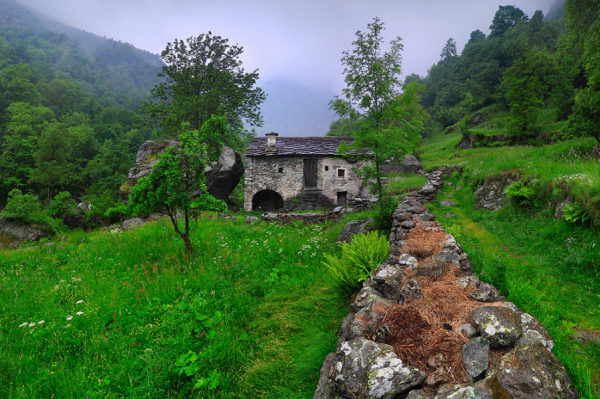
Over at one of my favourite blogs, the administrator includes a weekly feature Tiny House in a Landscape. It's a photo of a tiny house captured in its natural settling.


As I just commented over there, I think the series should be up for an award. The nostalgic photos pull at the heartstrings. They evoke both the yearning for home and the awe of nature’s sublime beauty.

Almost every week, I download the featured photo and use it for my desktop background. 

Wednesday, April 14, 2010

Three Housing Proposals - Three Rejections

... because neither political entity, city or province, would commit before the other would.

An article out today, written by Monte Paulsen for The Tyee, backs up my comments in yesterday's economicus ridiculous post regarding tiny homes. I wrote then that the problem is not a shortage of ideas for extremely low-cost, low-maintenance, environmentally-friendly shelter for permanent housing. The problem is politicians without the courage of vision or the willingness to act.

Paulsen writes of three great proposals made to provide CHEAP dwellings to house people who are homeless or of low income in Vancouver. That is, truly 'affordable housing' for anyone, not just affordable for the middle class.

The proposals went to the province for consideration. All three proposals were turned down.

The city wouldn't commit because the province wouldn't commit. The province wouldn't commit because the city wouldn't commit. And round and round we go ... as people die.

Saturday, April 10, 2010

Sweet Tiny Homes

Yes, more sweet, tiny, extremely low-cost, low-maintenance homes. But people of low-income need not apply.

Am always on the lookout for a tiny place of my own, with a bit of land to grow my own food. Most recently, I inquired about a fifth wheel already on-site in a mobile home park about one and a half hours north of here.

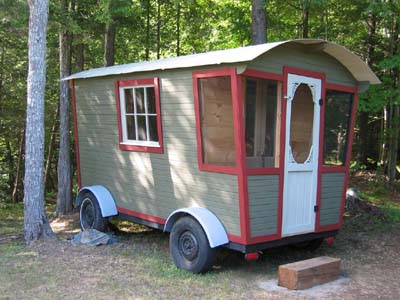
As I've written elsewhere, there's no shortage of great ideas that would, if there were the political will, address the housing shortage virtually overnight. Daphne's Caravans is just one tiny part of the rapidly growing global tiny house movement.


Many of the tiniest of these tiny dwellings haven’t a washroom or toilet, although most do have a range and kitchen sink. Were it possible to get government to free up land or for private developers to be given the incentive, block neighbourhoods or tiny villages could be created of these tiny homes; and all built using recycled or scavenged materials. They’d surround communal food gardens and a commons building containing washrooms, laundry, recreational and exercise facilities, and a kitchen for community meals.

Such developments could be built along the lines of the co-housing principle (not the same as co-op housing). However in this case, the goal would be to make the living spaces cheap enough that anyone, even those living in the lowest decile of income, could afford their own tiny place.

I’ve yearned for a tiny cabin or trailer all my life, a place just like one of those tiny caravans and where I and my furry animal companions can live in peace. One hundred square feet would be ample for me. However, at age 60, I doubt I’ll realize that dream.

Our politicians, all the way from local to federal, lack the courage of vision.

Thursday, April 8, 2010

UPDATE: Status of Women Minister Buys $880K Ottawa House

On Helena Guergis' husband Rahim Jaffer, see this outstanding investigative report that appeared on the front page of today's Toronto Star. If you don't get the Star in your area, you might want to take a look at this PDF capture of the Star's front page.

I wonder if the Liberals' request for the ethics commissioner to review Guergis' mortgage deal, which was arranged in her husband's former Edmonton riding, might not now be granted? Alternatively, she could resign, as she should have done after her airport tantrum.

Friday, March 12, 2010

Imagine What It's Like

[Reprise from a post written September 2009 on Challenging the Commonplace]

Imagine what it's like to have yearned for a tiny place all your own, a tiny house or a trailer, one whose maintenance fits within your budget and where you and your furry companions can live in peace.

Imagine that someone comes forward and says to you: "I'll buy you a tiny house or a trailer; just find a place to put it."

Imagine that, feeling hope for the first time in a decade, you try and you try and you try and nowhere can you find land on which to place a tiny home. No RV pad is available, although there's no shortage of used trailers for purchase. No land is available that hasn't restrictions on the type of structures allowed; houses must be of certain minimal dimensions, they must have this or that amenity, and so on.

Imagine then that you must say to your potential benefactor: "I can't accept your gift of a tiny place. I can find nowhere to put it."

Imagine hope fading.

Imagine that the same someone comes forward and says to you: "Alright, if I can't buy you a tiny house or a trailer, then let me buy you a scooter. Then you'll be able to get about without pain. Just tell me the total cost, including insurance, and I'll send you the money."

Imagine hope rising.

Imagine enthusiastically checking online and deciding with the help of your potential benefactor whether it should be a Honda Jazz or a Yamaha Vino. Imagine scouting out the prices, learning about the licensing and insurance requirements, adding up the costs. Imagine reporting back your findings and the two of you deciding on the Vino.

Imagine the excitement growing, not just yours, but hers too...

Then imagine thinking: "Wait. Consider what you're doing. You don't live in a secure place. This is a high-theft area. There's nowhere to keep your scooter safe, nowhere to keep it plugged in: no garage, no locker, no area inside the building. There's no carport, no awning under which your scooter can be kept from 30 to 40 cm snow dumps, no protection from the snow plow when it comes to clear the parking lot. The scooter will be exposed to vandalism and theft and the elements all year-round; and there's nothing you can do about it."

Imagine.

Possession of a scooter depends on relocation to a more secure residence.

Now suppose that word came in the spring of a rare, subsidized, seniors residence. It's one of the few rental places in this province, subsidized and not, that accepts pets.

Imagine someone applying to that development and the applicant being put on a waiting list.

Imagine hope waits.

ETA March 12/10: Possession of a bicycle also depends on getting a more secure, accessible residence, since I wouldn't be able to carry one up and down the three flights of stairs here. An electric bicycle could serve the purpose as well as, and be cheaper than a scooter, something my benefactor and I discussed a few weeks later.

Later in the year, I also heard of a second subsidized housing development that would accept pets. It, too, is on one of the Gulf Islands. This suggests that smaller, more close-knit communities and ones nestled in a natural rather than built environment, see the oddity of humans being forced to separate themselves not just from flora but fauna too. It's not a natural circumstance that we live lives isolated from the natural environment.

I applied to that second housing development, but have yet to receive an acknowledgement. Have called twice, using SkypeOut, and each time got their answering machine. Not having a phone, I've been unable to leave a number on their answering machine. Perhaps they receive applications and never send acknowledgements, or they didn't get my application, or they've declined to put it on their waiting list and haven't communicated that to me.

Friday, February 19, 2010

Necessities: Housecleaning

One advantage to having a near-empty place is not having so much to keep clean.

I've actually got more stuff in this closet of a computer room than I do in the big room. There's the telephone table in the corner to the right of me, with (disconnected) fax machine; in front is my little computer cart, with Mac mini, monitor, speakers and printer; and behind me is a two-drawer file cabinet. Then there's this chair (one of Kiltie's scratching posts) and two plastic-fabric cat houses - acquired free from my local ReUseIt place. All this in a space less than 30 square feet.

It works though and I never feel closed in. From here I can look out through the three foot high window that runs across most of the main room. Today, the sun is shining and I can see the tree opposite starting to bud.

In the main room is a daybed, one round wooden table, a bookcase and an old wooden rocking chair. My friend Ronnie gave me the wooden table, and the bookcase and rocker were picked up for free. The last was left behind by a former tenant of this building.

The bachelor units in this building have counter-table tops that run between the kitchen and the main room. Above are hutch-style shelves which back onto cupboards on the other (kitchen) side. The counter-table top is the largest surface to keep dust-free.

It's not a big deal, therefore, to keep my furniture, such as it is, and counter surfaces clean. Most require only a damp cloth. The wooden table, bookcase, computer cart and telephone table need better treatment. Fortunately, I received a coupon for a free can of Pledge not that long ago. That will last me quite a long time.

For the bathroom, I tend to clean up as I use it. After each shower, I wipe down the shower curtain, walls, tub, etc. Then each time I clean up the cats' commode, I do a more thorough job with a proper cleanser. The sink, mirror and countertop I wipe down everyday, after my daily wash; again, I do a more thorough job when it's time to clean the tub.

My major housecleaning concern and biggest challenge is the floors. I sweep the bare floors everyday with a regular broom. The broom isn't very good and tends to repel fluff and dust rather than attract it.

There are two places where there's wall-to-wall carpeting: in this computer closet and the entryway. I've a Bissell carpet sweeper I use for the carpets. It actually works for bare floors too, but sweeping with a broom is better, even the broom I have.

Cleaning the floors isn't so easy, not with the condition of my back. I can get down on my hands and knees to clean, but moving once I'm down there and getting back up again is difficult, not to mention very painful. Crawling to clean the bathroom and kitchen floors I've done and can still do - although even that I do as little as I can get away with, because regardless of their small size there's still the problem of getting back up again.

Cleaning the floor of the big room is the greatest challenge and, frankly, something I've been unable to do for some time. Instead, all I can manage is spot clean, as and when I see that something has spilled or a certain furry critter has up-chucked a hair ball.

Back in the fall 2009, I got a free Swiffer WetJet, thanks to a reader. It came with two pads. I cheerfully used them to clean the floor of the main room. I imagine I looked as happy as that woman in the ads. It was so nice to have a clean, shining floor and the fresh scent that went with it.

I wish I could get more wetjet pads, but my budget won't allow it. In the meantime, I've been wracking my brain for alternatives.

Nothing so far. So am back to spot cleaning.

Necessities: Animal Companions

Recall the number of times you've seen people living on the streets who have animals with them.

Look at the photo section of websites like that for the tent city Dignity Village.

What do you notice, with more frequency than you might expect?

What I notice are the animal companions. For quite awhile, Dignity Village had only photos of people with pets; only later did they start adding pictures of dwellings, gardens, and so on.

For some of us, having an animal companion is as necessary to our survival as food and water. Yet few mental health professionals acknowledge the link, which is more prevalent for women, or argue on behalf of those who would be denied an animal companion for the sake of property rights, as though such purported rights should outweigh the right to survival.

The vast majority of landlords in British Columbia, including government-run BC Housing and private subsidized housing projects, would deny us that necessity. Rare is it to find in this province a dwelling that will accommodate someone who has an animal companion; as rare, is it to find government or private subsidized housing developments that allow pets.

Therefore, people who are already challenged to manage with so little money, and who also may have health challenges, are challenged further to find places to live. Such people are expected to choose between having housing they can afford, are actually DENIED housing they can afford, and staying with their animal companions who they need as much as they need air to breathe.

The rationale for denying tenants animal companions is always this: "Some people don't look after their pets properly." In landlord-speak that means: "I've a right to protect my property from damage; since pet owners are more likely to leave the place in a mess than people who don't have pets, I don't rent to them."

Hogwash. Owners are as likely to get their places trashed by non pet owners as they are by people who have pets.

You needn't take my word for it.

A couple of years ago, I heard of a property owner who rents ONLY to pet owners. Said she'd found them to be more reliable, considerate and clean, compared to tenants to whom she'd rented who hadn't pets. She'd been renting various properties to people for decades - unfortunately, all out of my budget's reach.

As for my place, a 400-square foot bachelor apartment, you'd never know there were two cats here. There's no smell, no damage to floor or carpet, no sign of them anywhere. I brush my cats daily, which helps reduce cat hair from getting everywhere. I dust and sweep the place regularly and keep the litter box spotless.

I keep the litter box in the tub, near the faucet end and pull the shower curtain almost completely across. This requires the cats to walk to the end of the tub to enter or exit. The commode sits on an upside down rubber mat with the grippers facing upward. As the cats exit their commode, the mat's grippers pick up litter bits from between their furry toes. The litter box I keep clean by removing any solid waste immediately. For litter, I use pine wood pellets, which have a nice natural scent and happen to be the least expensive and most natural litter to use. (The SPCA uses it too.) When wet, the pellets expand into sawdust.

My one guilt is sometimes I forget to remove Kiltie's scent marking, the black streaking one finds at shin level at the corners of walls. When I do remember, the streaks are gone in a single swipe. Don't know why, but only Kiltie marks her territory, never Brodie.

Both cats are well-behaved and never spray. For scratching, they've a cat condo and (sigh) this upholstered computer chair.

Thursday, February 18, 2010

Necessities: Housing

I moved into this 400-square foot bachelor apartment on October 19, 2002. It suits me just fine and is quite a nice, bright bachelor apartment, as such units go. It's also in a neighbourhood and community I've become used to. So I'd choose to stay here, except for three considerations.

First, it's on the third floor of a three-floor walk-up.

Pulling my shopping cart up 36 stairs, having already pulled it up a steep hill on the way home from getting groceries, is increasingly harder to do given my hip and back problems.

I would choose and have requested to move one floor down. Moving to the second floor would be almost as good as moving to the first floor. The latter doesn't have bachelor apartments anyway and I can't afford more than I'm paying now (which is already 80% of my income). The first floor is sub-basement, so you still have to navigate stairs. To reach the front door of the building, you walk up nine stairs. The first or second floor is another nine stairs, down or up. The advantage of the first floor is the back entrance; it has only five shallow stairs going down to the sub-basement entry.

All this is moot. My landlord won't allow me to move to another unit while keeping my rent the same. I'm currently paying $486 per month; new renters are paying $575 per month for bachelor units. That's what he insists I pay if I should move. It doesn't matter that I've been an ideal tenant, never late with my payments and so quiet people have said they didn't know my unit was occupied. In fact, the clear message from my landlord is that he'd rather take his chances on a troublesome, higher-paying tenant than keep tenants known to be reliable and trouble-free.

That brings up the second concern. How secure is this place for me, in terms of continued occupancy? Might my landlord try to jack up the rent anyway? What might he do otherwise to 'persuade' me to move out?

A third consideration is the absence of a place to keep an electric bicycle or scooter, two-wheeled or four-wheeled. There's nothing outside or on the ground floor, secure or otherwise, or with plug-in access. I anticipate needing something like that in the future in order to get around.

I'd not be so anxious to find a subsidized unit in a more accessible, secure building - not with SAFER, in another few months, starting to help me with the rent here - if the extra stairs weren't causing me problems and this building offered secure, ground-floor storage and plug-in options.

I don't really want to move. Regardless, I may have no choice but to stay. Private subsidized or public housing projects in BC are rare, which is another housing issue for people with special needs. Since I'll always need an animal companion, my housing options are thus even further limited.

Two subsidized housing places that allow pets came to my notice over the past year; one, thanks to a reader. I've applied to both but have heard back from only one of them, confirming receipt of my application and advising I'm on their list. Both would be nice places to live, so that's where my hopes lie now.

Friday, February 12, 2010

Shelter As Investment

When did a home morph into 'real estate'? When did the roof over one's head transform into a 'market opportunity'? When did our society start viewing the place where we raise our families, lay our heads, withdraw to soothe hurts, draw sustenance from our animals and contentment from growing things become valued strictly in terms of monetary worth?

I read articles like this and I feel sick with fury. One owner of a three-bedroom $600,000 home has flipped it for $5,000 above the asking price and something larger. How nice for her.

In the meantime, housing solutions not just affordable but CHEAP are never considered for people who have no shelter whatever, are at risk of losing what they have, or live in substandard housing. Oftentimes already built, onsight solutions are outright rejected for fear homeless people will move into the neighbourhood.

The logic of the latter never fails to baffle me. If people who are presently homeless acquire shelter in your neighbourhood, do they not subsequently become NOT homeless? And why is it OK for you to have decent housing but not someone else? Who the hell are you that your life should count for more?

It's not rocket science to reduce homelessness only to those people who choose it as a lifestyle. (Yes, there are those who do choose it.)

Temporary measures include permitting and supporting tent cities, such as Dignity Village, not bulldozing them.* They include providing serviced parking areas for people whose homes are on wheels - cars, trailers.

Permanent solutions must begin by changing the municipal by-laws that effectively enshrine NIMBYism. In few communities is it possible under current laws for the construction of a village of tiny houses. In my own community, laneway housing is still not permitted, despite Vancouver's recent example. (Regarding the latter, $150,000 to $200,000, which includes BC Hydro servicing, are the costs typically mentioned for the construction of a tiny house on existing property. The City of Vancouver is allowing these laneway houses only to be rented. Why would property owners bother? The costs cited are absurd. A tiny house can be built for one-tenth the price.)

The tiny house movement has coincided with the green movement. Downsizing is in vogue. Municipal laws and other regulations pertaining to buying property and house construction haven't kept up.

The problem of affordable housing isn't one of lack of innovative ideas for shelter materials, construction and community design. The developers are out there who would build these things.

The problem isn't affordability of the shelters themselves. People in the US are building their own homes for NOTHING, from recycled scraps, from shipping containers, from old railway cars. Others are buying materials for under $3,000. Still others buy their tiny houses pre-built for under $25,000. Then there is the mobile home option: fifth wheels and other trailers. Too many used trailers to count sit unoccupied on RV dealer lots.

In other words, the problem isn't the HOUSING or the sheltering structure.

The problem is systemic NIMBYism, the failure of municipalities to accommodate changing community needs, the lack of will on the part of politicians at all levels of government to open their eyes and see where the problems truly lie, and the "I'm all right" attitude that blinds too many property owners from seeing the need for change that would ultimately benefit us all.

The problem is the LAND on which to place the housing, land whose use is not restricted by municipal laws. The problem is ALLOWABLE housing.

The problem has NOTHING TO DO WITH AFFORDABILITY and EVERYTHING to do with keeping 'those people' out.

*See especially Chapter 4 of that document. Former residents of Toronto's Tent City talk about their homes, their community - the place they felt most supported - having been destroyed.

Monday, February 8, 2010

Skinny Savings Slowly Sinking

As with Ocean, I have applied for CPP at the age of 60, which comes, for me, in December of this year. The CPP income will be $261 a month.

Since I retired from paid work in June of 2009, my skinny savings have been sinking.

Last year my total income was $2,646.00 which came from two part-time jobs. This year I am relying on GST rebates at $760 for the year and a meager savings account that is around $2,500. I also have the same amount in investments which dwindles as the world market continues it's nose dive.

Currently, I receive $500 a month from my roommate/friend which covers the basics to run the house. This includes hydro, water, recycling, telephone/internet, house insurance/property taxes and the wood that is burned for heat. There is even $77 left over for general household maintenance. Some repairs, such as the gutters which were torn off during 2008/09's snowy season, have been let go, as I cannot gather enough to cover the expense.

While working, I had a modicum of financial security, but that has since dissolved. As I'm an expert on making ends meet I will continue the challenge to feed, clothe, shelter myself and live with a dignity that only a person hanging on by a thread can do.

Sunday, February 7, 2010

Budgeting: On approaching age 60

Having given the finer details of the why, how, and how much of my annual income, it's time to consider the future.

As I fell deeper and deeper into the poverty well in the early 2000s, all I could think of, between bouts of depression so bad all I wanted to do was pack it in, was trying to survive long enough to be eligible for CPP and BC's Supplementary Assistance For Elderly Renters (SAFER).

I turn 60 in July.

My CPP payments will begin late August and likely be around $265. I assume my rent will go to $510 or slightly more starting in July, so my SAFER supplement will be about $387. Assuming these figures to be right, my monthly income from these two sources will be $652. It's not enough, despite it being about the same amount I've been living on the past several years. It's not enough, because costs keep going up.

All along, I've known I'd have to keep some of my savings aside to bolster the income during those 60 months between age 60, when I'm eligible for CPP and SAFER and age 65, when I can start Old Age Security, the Guaranteed Income Supplement and BC's senior supplement.

I don't know how I'm going to do it. I've wondered out loud to a friend whether it wouldn't be better to go homeless now, at age 59, rather than be so at 63 or 64. Am I naive to hope that something will 'give' in the interim and by that time I'll be OK?

Because as I look at things now, it's either do that, go homeless now for a year or two and so save what's left or in fact, become homeless just as I turn 64 ... if I can make my savings last even that long.

The Why and How of a Lowest Decile Household

Daphne and I have mentioned that each of our households is in the lowest decile of income categories. That's half again Statistics Canada's low-income cut offs (LICOs), which are measured at the lowest quintile of household incomes.

Here are the LICOs for 2008 for family sizes of one to four persons:

LOWEST QUINTILE (one-fifth):

Community Size
RuralUrban
Under 30K30K-100K100K-500KOver 500K
Family sizeAnnual household income
1 person12,01913,75415,34415,53818,373
2 persons14,62816,74118,67618,91122,361
3 persons18,21520,84523,25523,54827,844
4 persons22,72426,00729,01329,37834,738

The list continues for families of 5, 6, and 7 or more persons.

Daphne and I each live in the Cowichan Valley, which has numerous smallish communities. At last census, the Valley's total population was 79,000. It has seen a big box boom in recent years, so we're likely closer to 100,000 now.

For the table below, I've divided the LICOs into two, to show what the lowest decile of income looks like:

LOWEST DECILE (one-tenth):

Community Size
RuralUrban
Under 30K30K-100K100K-500KOver 500K
Family sizeAnnual household income
1 person6,0106,8777,6727,7699,187
2 persons7,3148,3729,3389,45611,181
3 persons9,10810,42311,62811,77413,922
4 persons11,36213,00414,50714,68917,369

This is the level at which Daphne and I subsist.

Why?

My income is so low because I can't do the work that is available in this community. Few jobs are anything but retail. That requires standing for long hours, reaching, twisting, bending. I've a bad hip from an old injury sustained in childhood. The wear and tear on the hip, and the associated scoliosis and arthritis that developed cause considerable pain. I can't do retail. And probably shouldn't, likely being an Aspie as well; however, I'd like to have given it a go.

I saved while still able to work because I knew it would get to this point. On a salary of only $12,500 per year, for the last four years ending December 2006, I saved $5,000 each year. That is, I saved $20,000... which makes my head explode when I read about people far more affluent who bury their heads in the sand.

During the 1990s, starting at the age of 41, I'd been a full-time student, so at the end of 2000, I also had $4,000 left from a doctoral fellowship.

That's what I've been living on ever since, that $24,000 plus interest, together with sales tax rebates and the very rare web design, research or writing contract. Of course, three years later, it's not $24,000 anymore.

People may wonder (I have at times) why I don't - or didn't - just spend my money, live relatively high on the hog for a year and then apply for 'financial assistance', i.e., welfare or disability benefits.

Well here's the thing: I have no dependent children, am fiercely independent, can't ask for help, have a hard time accepting gifts for the same reason, and loathe people trying to interfere with or control my life, also for the same reason. No way will I subject myself to this province's punitive welfare system, not with a childhood history of longterm abuse.

As for disability benefits, you must, in addition to everything else related to the degrading, demoralizing, dehumanizing application process - in BC you must apply for welfare before you can apply for disability benefits -, subject yourself to doctors who don't know you from Adam and resent the time they must spend filling out 30-page forms.

All of which explains why I've tried to live on no more than $8,500 annually for the last nine years (actually, $8,500 from 2001 to 2007 and $7,500 since 2008). Unfortunately, the interest on my shrinking balance hasn't kept up with the rising costs of shelter and food. Ergo, I've been falling behind each of those years.

Consider rent, now $486 per month. In 2003, it was $400 per month.

Hydro has stayed just about the same, at $12 per month. Barebones shelter, then, is $5,976 annually. That's almost 80 percent of my annual household income.

I've no phone. Instead I maintain a high-speed internet connection for reasons I've stated previously. The cost for that is $49.23 per month or $590.76 per year. I wish Canada had a policy that promoted internet access for all, since staying connected is essential for participation in a modern society.

Add up my costs so far - rent $5,976, hydro $144, internet $596.76 - and the annual total is $6.716.76. That leaves $783.24 for everything else.

So there you go, one budgetary tale of life in the poverty well ... to be continued.

Monday, February 1, 2010

BC "the best place on earth"

... tries to whitewash its Olympic message about homelessness.

According to the BC Government's Downtown Eastside 'Information' Centre (DTESIC):

  • Lack of affordable housing isn't the problem.
  • Lack of housing, period, isn't the problem.
  • Lack of LAND for affordable - even CHEAP - housing solutions isn't the problem.
  • Lack of municipalities with by-laws that encourage, rather than discourage, innovation in housing and housing density isn't the problem.

The problem of homelessness according to the DTESIC is apparently due to the unaccountable rise of mental illness. Thus the problem of homelessness in BC has to do with too many people here being mentally ill.

Because we all know homelessness is caused by mental illness, right?

WRONG

"They say that homelessness is about addiction and mental illness; it's not true," says Wendy Pederson of Carnegie Community Action Project. "We have a housing supply problem. We don't have low-income housing in this city. We have an income problem. We need to raise welfare."

Now that's the truth of the matter but let's not have truth interfere with our propaganda.

[Cross-posted at Challenging the Commonplace]